

How Did Blind People Do Makeup
The term "blindness" is relative considering it is the government and non the doctor that determines who is qualified to be referred to as "blind." In most instances, the term "blind" does not mean that an individual cannot see at all.
"Total blindness" refers to people who cannot see anything at all. The term "legal blindness" is used for people who suffer from poor eyesight. They can see, but their vision is very poor. People with eye and wellness problems like glaucoma, cataracts, and diabetes oft fall under this category.
In this list, we volition concentrate on people who are totally blind in one or both eyes. Here are 10 things that these blind people see.
10 Nada
Describing Colors As A Blind Person
"What exercise you see?" That is one question most blind people are sick and tired of answering. The answer is "nothing." Zip every bit in naught. Not black or any, simply goose egg. Explaining the concept of seeing nothing to someone with intact vision is like trying to explain the concept of colour to a blind person.
Can y'all draw colour to someone who has been blind from nativity? No. In the same way, blind people cannot explain "nothing" to someone who has had intact eyesight from birth.
However, there is a method to run into nothing. First, close one centre. Then concentrate on something else with the other eye. Make sure you concentrate. At present, at this moment, you cannot see annihilation with the closed eye, not even the black yous will see when you close both eyes. That nothing you lot are seeing with the closed eye is the same null blind people see.[ane]
9 Light
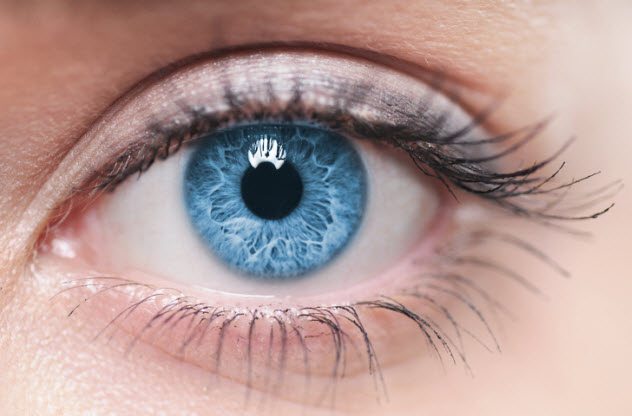
In 1923, Clyde Keeler, a student at Harvard University, discovered that the pupils of bullheaded mice reduced in size when exposed to light. At that time, nosotros already knew that humans and mice detected low-cal with 2 photoreceptors (chosen retinal photoreceptors) located inside the retina. Notwithstanding, in the example of the mice, the photoreceptors should non accept been active because the mice were blind.
Keeler soon realized that humans and mice accept a third photoreceptor chosen the "intrinsically photosensitive retinal ganglion cells" (ipRGCs). Unlike retinal photoreceptors, which send information about the light to the image processing part of the brain to create what we call vision, ipRGCs send the information to different parts of the brain just practise not contribute to vision.[2]
In another study, a group of researchers from the University of Montreal experimented with three blind people. The squad, led by Gilles Vandewalle, kept the subjects in a room and alternated between switching a light on and off. So the researchers asked the subjects whether the calorie-free was on or off.
They discovered that the bullheaded people gave the correct respond near of the fourth dimension. There was a caveat, though. Their brains had to be in a state of agile use or they might not be able to detect the change in lighting.
eight Facial Expressions
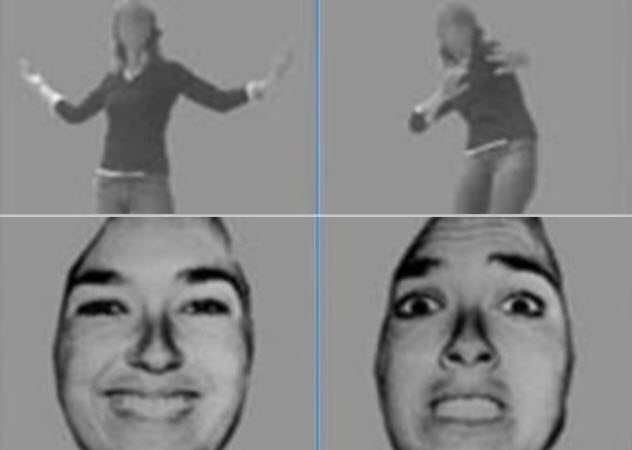
Humans mostly experience emotional contamination. This is a phenomenon whereby someone reacts to the facial expressions or behavior of another person—for instance, someone smiling because someone else smiled or yawning because someone else yawned. Bullheaded people feel this, too. They might not see y'all quite all right, but they can detect your facial expression and respond accordingly.
Nosotros know this from the results of a study by Marco Tamietto, a researcher at Tilburg University in holland. Tamietto experimented with two blind people, each of whom went blind in one eye after suffering harm to their visual cortex. The visual cortex is the office of the brain that processes visual information from the eyes. It is so of import to vision that damage to it alone without any harm to the optics is plenty to cause blindness.
Tamietto showed the subjects pictures of grin or frowning people, alternating betwixt the eyes serving the good and the damaged visual cortex. He observed that they were quicker to react to the images exposed to the eyes serving the damaged visual cortex than the optics serving the undamaged visual cortex. Then do not exist surprised if you smiling at a blind person and he smiles back.[three]
7 Everyone Else Including Themselves (During Nigh-Death Experiences)

Our knowledge of well-nigh-death feel (NDE) comes from people who have institute themselves on the verge of death. Some say that they saw themselves walking through a dark tunnel toward a lite, while others claim to meet with people they know or exercise not know. A third category of people written report existence outside their bodies and even saw themselves and the people around them in the living world.
To prove that they were not simply bluffing, some have even gone on to describe their environment and what happened while they were supposed to be unconscious and dying. Some blind people fall into this third category. Many even reported regaining their vision during NDE just later on they left their bodies.
In the 1990s, Dr. Kenneth Ring, a professor of psychology at the University of Connecticut, conducted research into reports of blind people regaining their eyesight during NDE. Xv of his 21 instance studies—all bullheaded—reported regaining their eyesight during an NDE. Iii said that they did non run across anything, and the last three were unsure whether they saw annihilation.
Ane man reported finding himself in a library filled with billions of books and seeing them clearly. Vicki Umipeg, another patient who concluded up in surgery after a nasty motorcar accident left her with a fractured skull, reported seeing herself and the doctor operating on her afterward she left her torso. Then she went through a tunnel and met with some people made of light. She was 22 at that time and had been blind since infancy.[4]
6 Nightmares
 Nightmares are the result of the stress and emotions nosotros feel while awake. Thanks to research conducted past the Danish Center for Slumber Medicine, nosotros at present know that people born blind are four times likelier to feel nightmares than the average person considering they experience more stress and emotions while awake.
The research involved analyzing the dreams of 50 people. Twenty-v were blind, and 25 could see perfectly well. Eleven of the bullheaded were built-in blind, while the remaining 14 went blind during their lifetimes. According to the study results, people who were born blind experienced nightmares 25 percent of the time. However, nightmares occurred only 7 percentage of the time for people who went blind during their lifetimes and 6 pct for people who could see.
The research also revealed the disparities between the dreams of people in the three groups. Showtime, nigh blind people—whether they were built-in blind or went blind during their lifetimes—frequently dreamed nigh being in awkward social situations and car accidents.
Notwithstanding, people born blind did not have dreams involving them seeing anything with their eyes. Most of their dreams related to other senses similar sound, taste, smell, and bear upon. For comparison, people who could still come across had dreams in which they saw with their optics. People who went blind during their lifetimes too had dreams where they could run across with their eyes, simply it lessened over time.[five]
v Pop-Up Ads

Yous are hither correct now considering y'all are using the Net. And similar every other Internet user, you should know nearly the existence of online advertisements. Online ads come in various forms, but the virtually disturbing and irritating are pop-up ads. You know, those ads that suddenly appear on the screen and destroy what was previously a good browsing feel.
The first popular-up advertisement code was written by Ethan Zuckerman over twenty years ago. Zuckerman has already apologized for writing the code for the advert, which he calls the "Internet'southward original sin." However, we practise non know whether visually impaired people will have his amends considering these ads have become their nightmare.
To the visually impaired, a pop-upwardly ad is the Internet's version of a streaker. Information technology suddenly appears unannounced, delays whatsoever activity was in progress, and continues to constitute a nuisance until it is eliminated. Most of the fourth dimension, blind people are not even aware that they have encountered a pop-upwards advertising and could be v minutes into it before they realize what is happening.
This occurs considering totally blind people access the Internet with screen readers that recite the contents of the page to them. Whatsoever trouble they experience with pop-up ads becomes worse when the ad lacks a close button. Even when they manage to close the advertizing, the screen reader restarts from the top of the page and goes through the whole article once again.[vi]
Ad blockers would have solved this problem, but some websites practise not allow them because they need to display ads to make money. Programmers of pop-up ads have too developed methods of bypassing the ad blocker to show the pop-ups anyway.
4 Movement
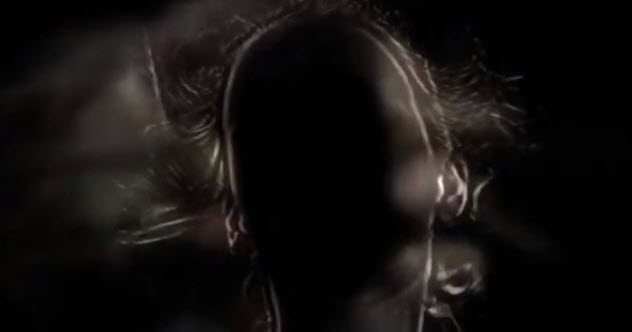
At 29, Milena Channing suffered a devastating stroke that left her blind. She thought that she had lost her sight forever until she realized that she could see moving water when bathing her girl. She informed her doctor, who thought she was only hallucinating. He told her, "You lot're blind, and that's information technology!"
Channing did not take her medico'southward discussion for information technology. With time, she realized that she could see falling rain, the steam leaving her hot cup of coffee, and the swinging ponytail of her daughter. Even so, she could not see her daughter, the loving cup of coffee, or anything else. Doctors afterwards informed Channing that she was experiencing "Riddoch's phenomenon," which causes blind people to but see moving objects.
This was possible because the stroke did non harm the office of Channing's brain responsible for processing moving objects. Channing soon realized that her "vision" improved whenever she was moving. And then she got a rocking chair.[seven]
3 Visual Hallucinations
Charles Bonnet Syndrome (CBS) | Bee's story
Blind people experience Charles Bonnet syndrome (CBS), which is just another name for visual hallucinations. They are nearly like regular hallucinations except that blind people are aware or eventually learn that the things they see are not there. This condition is common among people who accept just lost their eyesight and continues for up to a year and a half before ceasing. However, some people experience it for up to five years subsequently going blind.
One 69-year-sometime man started suffering from CBS half-dozen months after he lost his sight. He reported seeing abnormal shapes, people, and animals, including a spider that he had even attempted to kill. He also reported seeing people he knew sitting next to him.
The cause of CBS remains a mystery, but researchers believe that it might consequence from the brain trying to make up for the loss of vision. This theory is backed by an experiment in which 13 people were blindfolded to mimic the effect of incomprehension for five days. X participants experienced visual hallucinations after just i day.[8]
2 Color

Although people built-in bullheaded might come across naught, people who went bullheaded later on seeing for some time might see other things like color. One is Damon Rose, a BBC announcer who went blind afterwards a surgery he underwent equally a child over 31 years agone. These days, he sees color, lots of color. In fact, he sees so much color that information technology's distracting for him.[ix]
In an article written for the BBC, Rose reported that the colors flash like lights and come in dissimilar shapes. They too modify rapidly. Sometimes, a color even has another color as its groundwork. Interestingly, Rose says that the but thing he never sees is darkness. And that is the one affair he misses the most.
i Everything
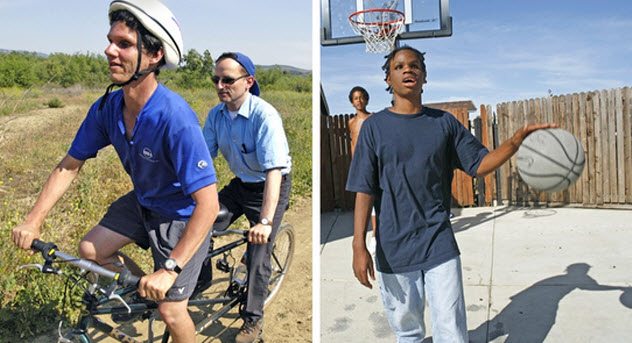
Some blind people accept learned to use echolocation to find their way around. That is, they produce a sound and expect for it to bounce off obstacles and echo dorsum to them. With the returning echo, they tin find the size and location of obstacles and carefully avoid them.
This is the same method used by bats and dolphins to find their way around. At that place is a catch, though. Dissimilar bats that use echolocation to detect small insects, humans require the object to exist at least the size of a glass cup.
Daniel Kish is a blind person who has learned to "encounter" with echolocation. As a toddler, he suffered from bilateral retinoblastomas, a type of cancer that afflicted the retinas of his optics. The cancer could not be eliminated without destroying his eyes, then he lost both eyes before he turned xiii months old.[10]
At age two, Ben Underwood also lost his optics to bilateral retinoblastomas. He independently developed the power to apply echolocation to replace his eyesight. Ben was so good that he could walk, ride a bicycle, skateboard, and play games without using a guide dog, cane, or even his hands. It was almost as if he was not blind. Yet, he died in 2009 afterward the cancer returned.
Source: https://listverse.com/2018/04/04/10-fascinating-things-blind-people-see/
Posted by: hamlinspinhe.blogspot.com
0 Response to "How Did Blind People Do Makeup"
Post a Comment